

The global race for artificial intelligence dominance has entered a decisive and deeply political phase. What once appeared to be a competition over algorithms, talent, and innovation has increasingly become a struggle over physical infrastructure—specifically, advanced semiconductors. At the center of this contest stands Nvidia, the American chipmaker whose graphics processing units have become the backbone of modern AI development.
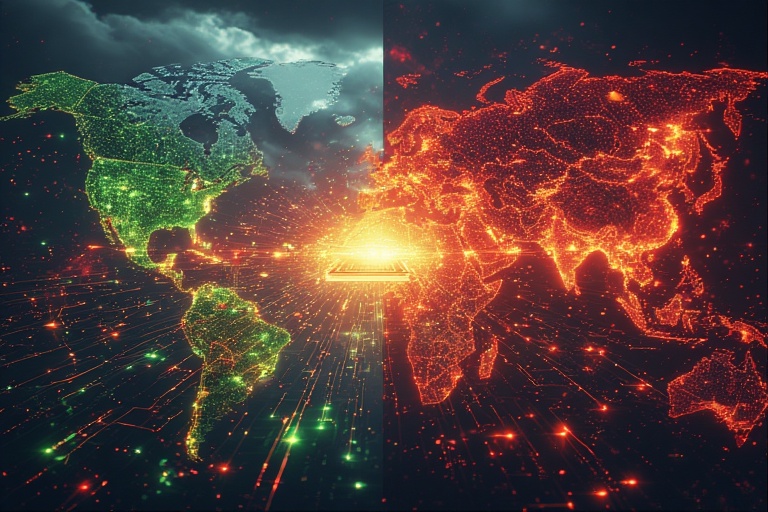
Donald Trump’s renewed focus on reshaping America’s export-control regime around Nvidia reflects a broader ambition: to entrench U.S. leadership in artificial intelligence by controlling access to the most critical hardware inputs. Yet while the strategy is bold in intent, its execution risks undermining the very advantage it seeks to preserve.
China’s Software Surge and America’s Hardware Stronghold
In recent years, the AI gap between China and the United States has narrowed dramatically in software. Chinese research labs and tech firms now produce large language models and vision systems that rival—or sometimes outperform—their Western counterparts on widely accepted benchmarks. This progress has eroded earlier assumptions that China lagged irreversibly behind in AI capability.
Hardware, however, remains the decisive constraint. High-end AI training still depends on advanced chips that China cannot yet manufacture at scale. Nvidia’s latest accelerators, optimized for massive parallel computation, remain beyond the reach of domestic Chinese fabrication capacity. This asymmetry has turned Nvidia into a geopolitical lever.
Trump’s Export-Control Reset
Trump’s approach to export controls represents a sharp departure from previous incremental policies. Rather than narrowly restricting the most advanced chips, the strategy aims to redraw the entire framework governing semiconductor exports to China. The logic is straightforward: keep Chinese AI development dependent on American hardware, but only on terms dictated by Washington.
In theory, such dependency could allow the U.S. to slow China’s military and surveillance-related AI advances while retaining commercial leverage. In practice, the policy risks triggering unintended consequences across global supply chains and innovation ecosystems.
The Illusion of Technological Dependency as Strategy
The assumption underlying Trump’s plan is that China can be permanently “hooked” on Nvidia chips without developing viable alternatives. History suggests otherwise. When access to critical technology is restricted, nations with sufficient resources and political will tend to accelerate domestic substitution efforts.
China’s semiconductor self-sufficiency initiatives have already intensified under prior export controls. By tightening the screws further, the U.S. may inadvertently catalyze faster innovation in Chinese chip design, manufacturing techniques, and alternative computing architectures.
Nvidia’s Uneasy Position Between Profit and Policy
Nvidia is not merely a passive instrument of U.S. policy. It is a publicly traded company with global customers, supply chains, and revenue dependencies. China has historically represented a significant portion of Nvidia’s data-center revenue, particularly for AI accelerators adapted to comply with earlier restrictions.
Trump’s aggressive policy posture places Nvidia in an uncomfortable position: comply fully and risk losing long-term market relevance in China, or resist and face regulatory and political backlash at home. Neither path is cost-free.
Fragmentation of the Global AI Ecosystem
One of the most profound consequences of export-control escalation is ecosystem fragmentation. AI research thrives on global collaboration, shared benchmarks, and interoperable platforms. Restricting hardware access encourages parallel, incompatible AI stacks to emerge.
If China is forced to build AI systems optimized for domestically produced chips, global standards may fracture. This would reduce efficiency, slow innovation, and increase costs worldwide—ironically weakening America’s competitive advantage.
Export Controls as Industrial Policy by Another Name
Trump’s plan effectively transforms export controls into a blunt instrument of industrial policy. Instead of nurturing domestic semiconductor manufacturing through investment, education, and workforce development, it relies heavily on exclusion and restriction.
While this approach may produce short-term leverage, it does little to address structural challenges facing U.S. chip manufacturing, including supply-chain resilience, talent shortages, and fabrication capacity constraints.
The Risk of Overplaying the Nvidia Card
Nvidia’s dominance is real but not immutable. AI workloads are increasingly diversifying, with alternative accelerators, custom silicon, and software-level optimizations reducing reliance on any single vendor. Overusing Nvidia as a geopolitical choke point risks accelerating this diversification.
Once alternatives mature, the strategic leverage disappears—but the diplomatic damage remains.
China’s Long Game in Semiconductors
China’s response to tightened export controls is unlikely to be reactive or short-sighted. Instead, it will likely double down on long-term investments in lithography, materials science, and chip design. While catching up to cutting-edge fabrication may take years, progress does not need to be perfect to be disruptive.
Even partial parity could undermine the rationale behind U.S. restrictions.
The Broader Geopolitical Signal
Trump’s policy sends a clear message: AI is no longer just a commercial technology—it is a strategic asset. This framing influences how other countries approach their own technology policies. Allies may feel pressured to align with U.S. controls, while others hedge by diversifying suppliers.
The result is a more politicized and less efficient global tech market.
Innovation Thrives on Openness, Not Containment
Historically, America’s technological leadership has been rooted in openness—open research, open markets, and open collaboration. While national security concerns are legitimate, excessive restriction risks undermining the innovation culture that produced Nvidia’s success in the first place.
Containment strategies may slow rivals temporarily, but they also constrain domestic creativity.
What a Sustainable AI Strategy Would Look Like
A more durable approach to AI leadership would combine targeted security measures with massive domestic investment. Strengthening STEM education, supporting semiconductor manufacturing at home, and fostering open innovation ecosystems would yield long-term dividends without provoking global fragmentation.
Export controls should be a scalpel, not a sledgehammer.
Conclusion: Power, Chips, and the Future of AI Leadership
Trump’s Nvidia-centric export strategy reflects a world where technological dominance is inseparable from geopolitical power. Yet the risks of miscalculation are immense. AI leadership cannot be preserved solely by restricting others—it must be continuously earned through innovation.
If America mistakes control for competitiveness, it may find that the future of AI leadership slips through its fingers, one chip at a time.
FAQs
1. Why is Nvidia central to global AI development?
Nvidia’s GPUs dominate AI training and inference due to unmatched performance and software ecosystems.
2. What is Trump’s export-control strategy targeting?
It aims to restrict China’s access to advanced AI chips while preserving U.S. leverage.
3. Why could this strategy backfire?
It may accelerate China’s push for domestic semiconductor alternatives.
4. Is China close to matching U.S. AI software?
Yes, Chinese AI models now rival U.S. systems on many benchmarks.
5. Why does hardware still matter more than software?
AI performance depends heavily on advanced chips for training and scaling models.
6. How does this affect Nvidia as a company?
It risks losing long-term access to a major market while facing political pressure.
7. Could global AI standards fragment?
Yes, restrictions may lead to incompatible AI ecosystems worldwide.
8. Are export controls a form of industrial policy?
Increasingly, yes—though often without direct domestic investment.
9. What’s the alternative to heavy restrictions?
Targeted controls combined with massive investment in domestic innovation.
10. What’s at stake in this policy shift?
The future balance of global AI power, innovation, and technological leadership.