

For decades, the technology industry has pushed toward one goal: creating truly immersive digital experiences that blur the line between the physical and virtual worlds. From high-resolution displays to spatial audio and increasingly sophisticated haptic feedback, the evolution of virtual reality (VR) has been relentless. Yet despite these advances, one critical sense has remained largely untouched—smell.
The absence of olfactory input has been one of the most noticeable gaps in immersive systems. While users can see and hear virtual environments with astonishing realism, the inability to smell them creates a subtle but powerful disconnect. This limitation has prevented VR from fully convincing the human brain that it has entered another world.
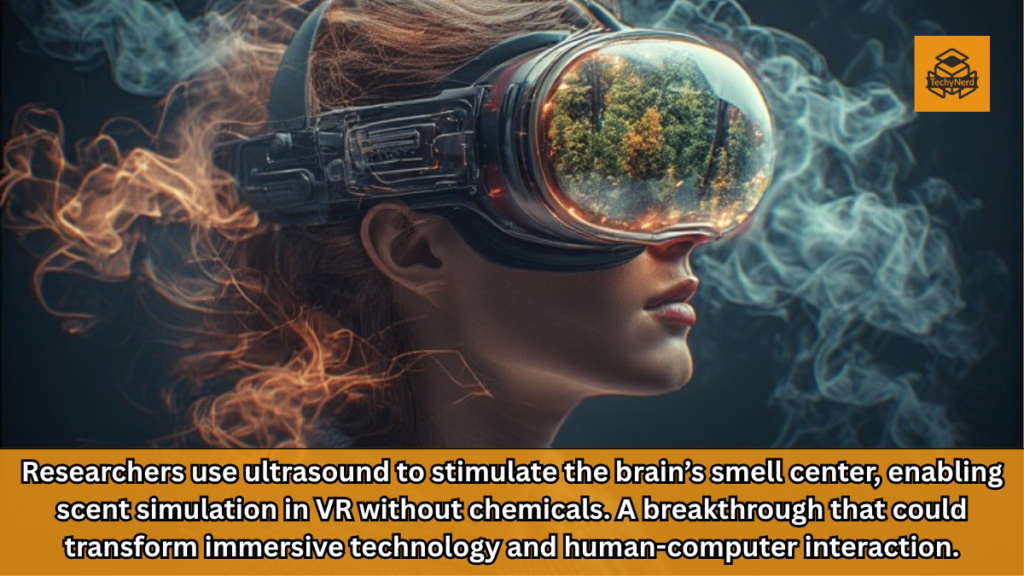
Now, a small group of independent researchers may have found a radically different solution. Instead of releasing chemical scents into the air, they have demonstrated a method to directly stimulate the brain’s olfactory system using focused ultrasound. If scalable, this breakthrough could redefine not just VR, but the broader field of human-computer interaction.
Why Smell Matters More Than We Think
Smell is often underestimated in discussions about sensory technology, but neuroscientists have long recognized its unique importance. Unlike vision and hearing, which are processed through multiple layers of the brain, olfactory signals travel directly to the limbic system. This region governs memory, emotion, and instinctive behavior.
Because of this direct connection, smell has a uniquely powerful ability to evoke vivid memories and emotional responses. A single scent can instantly transport someone back to a childhood moment or trigger a strong emotional reaction. This phenomenon is not incidental—it is deeply rooted in human biology.
In the context of virtual reality, this means that adding smell is not just about realism. It is about emotional immersion. Without it, even the most visually convincing simulations can feel incomplete on a subconscious level.
Historical Attempts to Simulate Smell
The idea of integrating smell into media is not new. As far back as the 1950s, systems like “Smell-O-Vision” and “AromaRama” attempted to bring scent into movie theaters. These early efforts relied on releasing fragrances into the air during specific scenes. However, they were plagued by technical limitations, poor timing, and audience discomfort, ultimately leading to their failure.
Decades later, similar ideas resurfaced during the early wave of modern VR in the mid-2010s. Several startups introduced accessories designed to attach to VR headsets and emit scents using chemical cartridges. These systems aimed to enhance immersion by synchronizing smells with virtual environments.
Despite initial excitement, these products failed to achieve mainstream adoption. The reasons were both practical and regulatory. Users needed to purchase and replace cartridges regularly, which added ongoing costs. The range of available scents was limited, and once released, smells tended to linger longer than intended, disrupting the experience.
Additionally, because these devices emitted chemicals, they faced regulatory scrutiny similar to other inhalable products. This created significant barriers to widespread commercialization.
A Radical Shift: Stimulating the Brain Directly
The new research takes a fundamentally different approach. Instead of attempting to replicate smell through external chemical delivery, the team targets the brain directly. Specifically, they focus on the olfactory bulb, the neural structure responsible for processing smell.
Using focused ultrasound, the researchers were able to stimulate this region non-invasively. The ultrasound waves pass through the skull and converge at a specific نقطة, creating localized stimulation without the need for surgery or implants.
This approach eliminates many of the challenges associated with traditional scent delivery systems. There are no cartridges to replace, no chemicals to regulate, and no lingering odors to manage. In theory, it allows for precise, on-demand control of olfactory experiences.
The Technical Approach Behind the Breakthrough
Achieving this level of precision is far from simple. The olfactory bulb is located behind the nasal cavity, making it a difficult target for external stimulation. Additionally, ultrasound waves do not travel efficiently through air, which complicates direct targeting from the front of the face.
To overcome these challenges, the researchers developed an unconventional solution. They positioned the ultrasound emitter on the forehead, using a gel-like pad to ensure stable contact and efficient transmission of sound waves. From this position, the ultrasound is directed downward toward the olfactory bulb.
The team used MRI imaging to map the structure of the skull and determine the optimal زاوية and depth for the ultrasound focus. Through experimentation, they identified a “sweet spot” involving low-frequency ultrasound and precise targeting parameters.
The system operates using short, rapidly repeating pulses, allowing for controlled stimulation of the target area. This level of precision is critical for producing consistent and recognizable sensory effects.
What Users Actually Experienced
One of the most intriguing aspects of the research is the subjective experience reported by participants. The researchers were able to induce sensations that users described as distinct smells, including fresh air, garbage, ozone, and burning wood.
Interestingly, participants noted a difference between what they described as “smells” and “sensations.” Some experiences felt localized and realistic, as though the scent had a physical source. Others were more diffuse and subtle, sometimes accompanied by additional sensations such as mild tingling.
The intensity of these experiences varied, often becoming more pronounced during light inhalation. In some cases, the onset was gradual, while in others it was immediate and striking. One participant reportedly reacted strongly upon perceiving a garbage-like smell, demonstrating the realism of the effect.
These results suggest that the brain can interpret ultrasound-induced stimulation in ways that closely mimic natural olfactory input, even without any physical scent present.
Implications for Virtual Reality and Beyond
If this technology can be refined and miniaturized, it could have profound implications for the future of VR. Imagine exploring a virtual forest and actually smelling pine trees, or walking through a digital marketplace filled with the aromas of food and spices. Such experiences would dramatically enhance immersion and realism.
However, the potential applications extend far beyond entertainment. In healthcare, this technology could be used for therapeutic purposes, such as treating conditions related to smell loss or providing controlled sensory stimulation for neurological research.
In training and simulation environments, realistic smell cues could improve learning outcomes by engaging multiple senses. For example, emergency response training could include the smell of smoke or hazardous materials, creating more effective and memorable scenarios.
The Broader Context: Writing to the Brain
Perhaps the most intriguing aspect of this research is its implication for brain-computer interfaces (BCIs). Most current BCI systems focus on reading neural activity, enabling applications such as controlling devices with thought.
This new approach represents a form of “writing” to the brain—delivering information directly to neural structures without invasive procedures. While still in its early stages, this concept opens the door to a wide range of possibilities.
In the future, similar techniques could potentially be used to simulate other sensory experiences or even influence emotional states. While such ideas remain speculative, they highlight the transformative potential of non-invasive neural stimulation technologies.
Challenges and Limitations
Despite its promise, this technology is still in the experimental phase. The current prototype is not practical for consumer use, requiring manual positioning and careful calibration. Miniaturization and integration into wearable devices will be significant engineering challenges.
There are also important safety considerations. Although ultrasound is widely used in medical imaging, its long-term effects on brain tissue in this context are not yet fully understood. Rigorous testing and regulatory approval will be essential before any commercial deployment.
Cost is another factor. Advanced ultrasound systems and precise targeting mechanisms are likely to be expensive, at least initially. This could limit adoption to enterprise or specialized applications in the near term.
The Road Ahead
The development of ultrasound-based smell simulation represents a bold step forward in sensory technology. While it may take years before this approach becomes commercially viable, its potential impact is undeniable.
As VR continues to evolve, the integration of additional senses will be critical for achieving true immersion. This research suggests that the solution may not lie in replicating the physical world, but in directly interfacing with the human brain.
The journey from prototype to product will require collaboration across disciplines, including neuroscience, engineering, and software development. But if successful, it could mark the beginning of a new era in human-computer interaction—one where digital experiences are not just seen and heard, but truly felt.
FAQs
1. What is the new smell simulation technology based on?
It uses focused ultrasound to stimulate the olfactory bulb in the brain instead of releasing chemical scents.
2. Does this technology require any cartridges or consumables?
No, it eliminates the need for cartridges by directly targeting neural structures.
3. How accurate are the simulated smells?
Early tests show recognizable sensations like fresh air, garbage, ozone, and burning wood.
4. Is the technology safe for human use?
It is still experimental, and long-term safety studies are required before commercialization.
5. Can this be used in consumer VR headsets today?
No, the current prototype is not yet suitable for consumer integration.
6. How does this differ from previous smell technologies?
It bypasses chemical delivery and directly stimulates the brain.
7. What industries could benefit from this innovation?
VR, healthcare, training simulations, and neuroscience research.
8. What are the main challenges for this technology?
Miniaturization, cost, safety validation, and regulatory approval.
9. Could this be used for other senses?
Potentially, though this remains speculative at this stage.
10. When might this technology become available?
It could take several years before commercial applications emerge.