

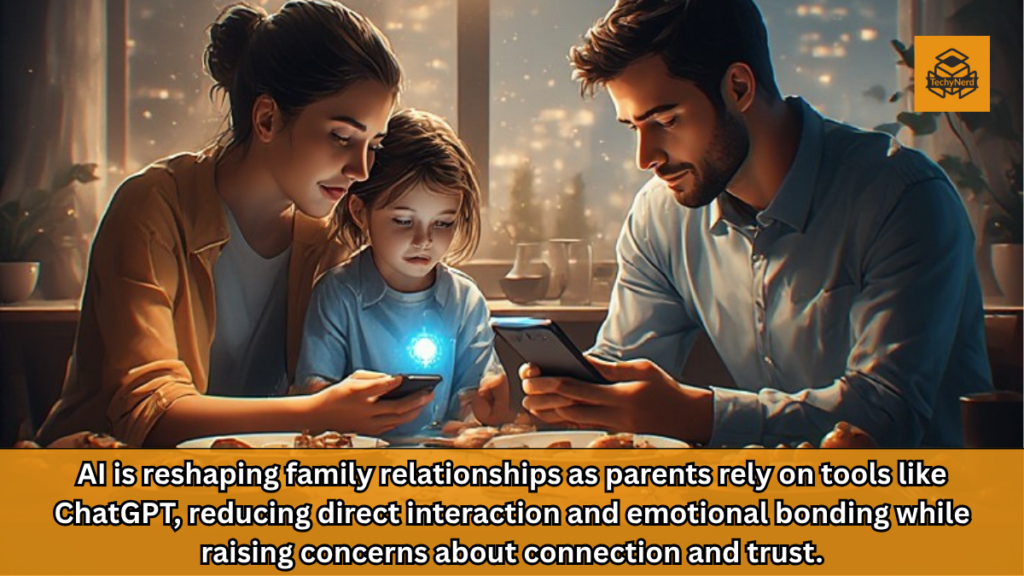
The rise of artificial intelligence has transformed industries, economies, and workflows, but its most profound impact may be unfolding quietly within households. What was once a tool for productivity is increasingly becoming a companion, advisor, and even a perceived authority figure in daily life. This shift is particularly visible in the evolving dynamic between parents and their children, where traditional roles of guidance and knowledge-sharing are being redefined.
In many families, AI-powered tools like ChatGPT are no longer just utilities. They are participants in conversations, contributors to decisions, and, in some cases, replacements for human interaction. This transformation raises critical questions about trust, dependency, and the future of interpersonal relationships in a digital age.
The Traditional Role of Parents as Knowledge Gatekeepers
For generations, parents have served as primary sources of knowledge, advice, and problem-solving within families. Whether it was fixing household issues, offering career guidance, or simply sharing life wisdom, parental authority was rooted in experience and trust.
This dynamic was not just functional; it was deeply emotional. Asking a parent for advice often carried an implicit desire for connection, reassurance, and shared understanding. The act of seeking help was as much about bonding as it was about finding solutions.
However, the emergence of AI tools has begun to challenge this long-standing structure. When a parent defers a question to an AI system, the interaction shifts from a relational exchange to a transactional one. The implications of this shift are subtle but significant.
The Rise of AI as an Everyday Companion
The adoption of AI tools among older generations has been surprisingly enthusiastic. While younger users are often portrayed as early adopters of technology, many parents in their 50s and 60s are embracing AI with a sense of curiosity and excitement.
This enthusiasm is driven by the versatility of AI systems. From generating recipes and planning trips to answering complex questions and offering advice, AI tools provide instant, seemingly authoritative responses. For many users, this creates a sense of empowerment and efficiency.
However, this convenience comes with a trade-off. As AI becomes more integrated into daily routines, it begins to occupy spaces traditionally reserved for human interaction. Conversations that once occurred between family members are increasingly mediated by technology.
Generational Perspectives: Trust Versus Skepticism
One of the most intriguing aspects of this phenomenon is the reversal of expectations between generations. Younger individuals, who grew up with digital technologies, often approach AI with caution. They are aware of issues such as misinformation, bias, and overreliance.
In contrast, many older users exhibit a higher level of trust in AI systems. This trust is not necessarily naive; rather, it reflects a sense of wonder at the capabilities of modern technology. For individuals who have witnessed the evolution from analog to digital systems, AI represents a remarkable leap forward.
This divergence creates tension within families. While parents may view AI as a helpful assistant, their children may perceive it as an intrusive or even disruptive presence.
The Emotional Cost of Delegating Connection
At the heart of this issue lies a fundamental question: what happens when technology replaces moments of human connection? When a parent redirects a question to an AI system, the immediate problem may be solved, but the opportunity for interaction is lost.
These moments, though seemingly trivial, are building blocks of relationships. They create shared experiences, reinforce trust, and strengthen emotional bonds. The absence of such interactions can lead to feelings of दूरी and disconnection.
For many individuals, the frustration is not about the use of AI itself but about what it represents—the gradual erosion of personal engagement. The desire is not just for answers but for conversation, understanding, and presence.
AI as a Tool for Understanding and Empathy
Despite these concerns, AI also offers potential benefits in family dynamics. Some users have found value in using AI to gain perspective on interpersonal relationships. For example, parents may use AI to better understand their children’s behavior or to navigate complex emotional situations.
In this context, AI acts as a mediator rather than a replacement. It provides insights that can enhance communication and empathy. However, the effectiveness of this approach depends on how the information is used. AI-generated advice should complement, not substitute, direct interaction.
The Risk of Overreliance and Cognitive Offloading
A critical concern in the widespread adoption of AI is the phenomenon of cognitive offloading. As individuals rely more on external systems for information and decision-making, their own critical thinking skills may diminish.
This is particularly relevant in family settings, where children look to parents as role models. If parents consistently defer to AI for answers, it may signal a reduced confidence in their own knowledge or judgment.
Over time, this could alter perceptions of authority and expertise within the family. The parent’s role as a trusted advisor may be partially transferred to the AI system, creating a नई hierarchy of information.
Cultural and Social Implications
The integration of AI into family life reflects broader societal trends. As technology becomes more pervasive, the boundaries between human and machine interactions are increasingly blurred. This shift has implications not only for individual relationships but also for cultural norms.
In many societies, family interactions are central to social cohesion. The replacement or mediation of these interactions by technology could lead to changes in how relationships are formed and maintained.
At the same time, the adaptability of families suggests that new forms of interaction will emerge. The challenge lies in finding a balance that preserves human connection while leveraging technological benefits.
Reclaiming Human Connection in a Digital World
Addressing the impact of AI on family dynamics requires intentional effort. Communication plays a crucial role in this process. Expressing the desire for personal interaction can help reestablish boundaries and expectations.
Rather than rejecting AI entirely, families can adopt a more balanced approach. AI can be used as a supplementary tool, while human interaction remains the प्राथमिक mode of engagement. This approach ensures that technology enhances rather than replaces relationships.
Conclusion: Navigating the Future of Family Relationships
The integration of AI into daily life is inevitable, but its impact on relationships is not predetermined. The way individuals choose to use technology will shape its role in their lives.
AI systems like ChatGPT have the potential to enrich experiences, provide valuable insights, and improve efficiency. However, they cannot replicate the depth of human connection.
As families navigate this नई landscape, the challenge will be to maintain the essence of relationships while embracing innovation. The goal is not to resist change but to guide it in a way that preserves what matters most.
FAQs
1. Why are parents increasingly using AI tools like ChatGPT?
They find them efficient, informative, and capable of handling diverse everyday tasks.
2. How does AI affect parent-child relationships?
It can reduce direct interaction, potentially weakening emotional connections.
3. Are younger generations more skeptical of AI?
Yes, they tend to question its accuracy and ethical implications more critically.
4. Can AI improve family communication?
It can provide insights, but it should not replace direct conversations.
5. What is cognitive offloading?
It refers to relying on external tools like AI instead of personal thinking.
6. Is AI replacing parental authority?
Not entirely, but it can influence how authority is perceived.
7. Why do some people feel disconnected due to AI?
Because it replaces moments of personal interaction and bonding.
8. Can AI help parents understand their children better?
Yes, if used as a supportive tool rather than a substitute.
9. What is the main risk of overusing AI in families?
Loss of critical thinking and reduced human connection.
10. How can families balance AI use?
By prioritizing human interaction and using AI as a secondary resource.