

Apple’s anticipated entry into the foldable smartphone market represents more than just another product launch—it signals a fundamental shift in how the company approaches device design, usability, and user interaction. According to recent industry leaks, Apple is placing an unusual emphasis on a seemingly simple feature: a dedicated Camera Control button. While this may appear incremental on the surface, it reflects a deeper philosophy that prioritizes ergonomics and real-world usability over raw hardware optimization.
This strategic decision highlights a broader trend within the tech industry where user experience is increasingly outweighing traditional metrics such as component density or specification superiority. Apple’s foldable iPhone, expected to debut alongside the iPhone 18 Pro lineup, appears to embody this philosophy in a highly deliberate way.
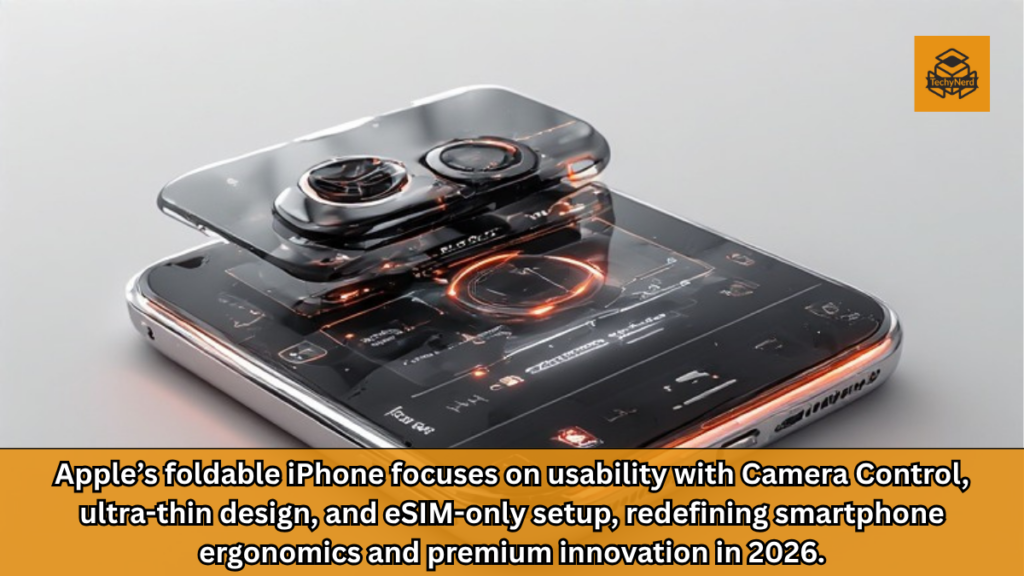
The Role of Camera Control in Foldable Ergonomics
Foldable smartphones introduce unique usability challenges that do not exist in traditional slab-style devices. When unfolded, these devices become significantly larger, often making one-handed operation difficult. Tasks such as adjusting camera settings or capturing photos can become cumbersome, especially when users must stretch their fingers across a wider display.
Apple’s solution—a dedicated Camera Control button—addresses this issue directly. By allowing users to operate key camera functions without relying solely on touchscreen input, the company aims to maintain usability even when the device is fully expanded. This approach suggests that Apple is not merely adapting to the foldable form factor but actively rethinking interaction models to suit it.
The emphasis on one-handed usability is particularly গুরুত্বপূর্ণ in an era where smartphones are expected to perform increasingly complex tasks. Apple’s decision indicates a recognition that hardware innovation must be complemented by intuitive control mechanisms.
Engineering Trade-offs: Function Over Form
One of the most striking aspects of this design choice is the reported trade-off involved. To accommodate the Camera Control button, Apple is said to have sacrificed valuable internal space that could otherwise be used for additional components or larger batteries. In a device category where every millimeter matters, this is a significant decision.
This trade-off underscores Apple’s long-standing design philosophy: prioritizing user experience even at the expense of technical efficiency. Historically, the company has made similar decisions, such as removing ports or reducing component redundancy to achieve a cleaner, more intuitive design. In the case of the foldable iPhone, the inclusion of a physical control mechanism reflects a belief that tactile interaction still holds value in an increasingly touch-driven world.
Competing in a Mature Foldable Market
By the time Apple enters the foldable smartphone market, competitors will have already established multiple generations of devices. Brands have experimented with various form factors, hinge mechanisms, and feature sets, often focusing on maximizing hardware capabilities.
However, Apple appears to be taking a different approach. Instead of competing solely on specifications, the company is focusing on refining the user experience. The inclusion of Camera Control is a clear example of this strategy, aiming to solve a practical problem rather than simply adding more features.
This approach could differentiate Apple’s foldable offering in a crowded market. While competitors may emphasize display size or camera count, Apple’s focus on usability could resonate more strongly with mainstream consumers.
Camera System Limitations and Strategic Choices
Interestingly, reports suggest that Apple’s first foldable iPhone may not include a telephoto camera, a feature commonly found in competing devices. Instead, the device is expected to feature only wide and ultra-wide lenses.
At first glance, this may seem like a disadvantage. However, it aligns with Apple’s broader strategy of optimizing core functionalities rather than maximizing feature count. By focusing on essential camera capabilities and enhancing usability through the Camera Control button, Apple may be aiming to deliver a more streamlined and reliable photography experience.
This decision also reflects the constraints of foldable device design, where space is at a premium. By limiting the number of camera modules, Apple can allocate resources more efficiently while maintaining a slim profile.
The Shift to eSIM-Only Connectivity
Another notable aspect of the foldable iPhone is its expected transition to an eSIM-only configuration. This move eliminates the need for a physical SIM card tray, freeing up internal space and simplifying the device’s design.
The adoption of eSIM technology aligns with Apple’s broader vision of a wireless, portless future. While this transition may pose challenges in regions where physical SIM cards are still prevalent, it represents a step toward a more integrated and flexible connectivity model.
For users, eSIM offers several advantages, including easier carrier switching and reduced hardware complexity. However, it also raises questions about compatibility and adoption rates in different markets.
Pricing Strategy and Market Positioning
The foldable iPhone is المتوقع to be positioned as a premium product, with pricing estimates ranging from $2,000 to $2,700. This places it firmly in the high-end segment, targeting early adopters and technology enthusiasts.
Apple’s pricing strategy reflects the complexity and novelty of foldable devices, as well as the company’s brand positioning. By entering the market at a premium level, Apple can maintain its reputation for high-quality products while gradually refining the technology over subsequent generations.
The relatively conservative production estimate of 10 million units suggests that Apple is approaching this launch cautiously, focusing on quality and user feedback rather than массовое adoption.
Display Technology and Form Factor Innovation
The foldable iPhone is expected to feature a 7.8-inch inner display and a 5.5-inch outer display, offering a versatile user experience that combines the functionality of a smartphone and a tablet. This dual-display approach enables users to switch seamlessly between compact and expanded modes, depending on their needs.
Apple’s expertise in display technology is likely to play a crucial role in the success of this device. Ensuring durability, color accuracy, and responsiveness in a foldable display is a significant challenge, and Apple’s approach will be closely watched by industry analysts.
The Broader Implications for the Smartphone Industry
Apple’s entry into the foldable market has implications beyond a single product. It signals a maturation of the category and may accelerate innovation across the industry. Competitors will need to respond not only to Apple’s hardware but also to its user-centric design philosophy.
The emphasis on ergonomics and usability could influence future device designs, encouraging manufacturers to prioritize practical features over purely technical advancements. This shift could lead to a new generation of smartphones that are not only more powerful but also more intuitive to use.
Conclusion: Redefining Innovation Through Usability
Apple’s foldable iPhone represents a thoughtful approach to innovation, যেখানে design decisions are guided by user needs rather than technical შესაძლებლობები alone. The inclusion of a Camera Control button, despite the associated trade-offs, exemplifies this philosophy.
As the smartphone industry continues to evolve, Apple’s focus on usability may prove to be a निर्णायक factor in shaping the future of mobile technology. Whether this strategy will resonate with consumers remains to be seen, but it undoubtedly sets a new benchmark for what innovation can look like in the foldable era.
FAQs
1. What is the main highlight of Apple’s foldable iPhone?
The key highlight is the dedicated Camera Control button designed for better ergonomics and one-handed use.
2. Will the foldable iPhone have a telephoto camera?
No, it is expected to feature only wide and ultra-wide cameras.
3. What is the expected price range?
The device may cost between $2,000 and $2,700.
4. Will the foldable iPhone support physical SIM cards?
No, it is expected to be eSIM-only.
5. When is the foldable iPhone expected to launch?
It is likely to launch in fall 2026.
6. What display sizes are expected?
A 7.8-inch inner display and a 5.5-inch outer display.
7. Why is Apple focusing on Camera Control?
To improve usability and ergonomics in a larger foldable form factor.
8. How many units will Apple produce initially?
Around 10 million units in the first year.
9. What chip is expected in the device?
The A20 chip is rumored to power the device.
10. What makes Apple’s foldable approach different?
Its focus on user experience and ergonomic design over hardware maximization.