

The transition of leadership at Apple marks one of the most consequential moments in the modern technology industry. When John Ternus steps into the role of CEO, he will inherit not only one of the most valuable companies in the world but also a legacy defined by two radically different yet equally successful leadership styles. The expectations placed upon him are immense, and the stakes are extraordinarily high.
Apple is no ordinary corporation. It is a cultural force, a design powerhouse, and a financial juggernaut that has consistently reshaped industries. From personal computing to smartphones and now spatial computing, Apple has played a pivotal role in defining how humans interact with technology. Leading such an organization requires a rare combination of creativity, operational discipline, and strategic foresight.
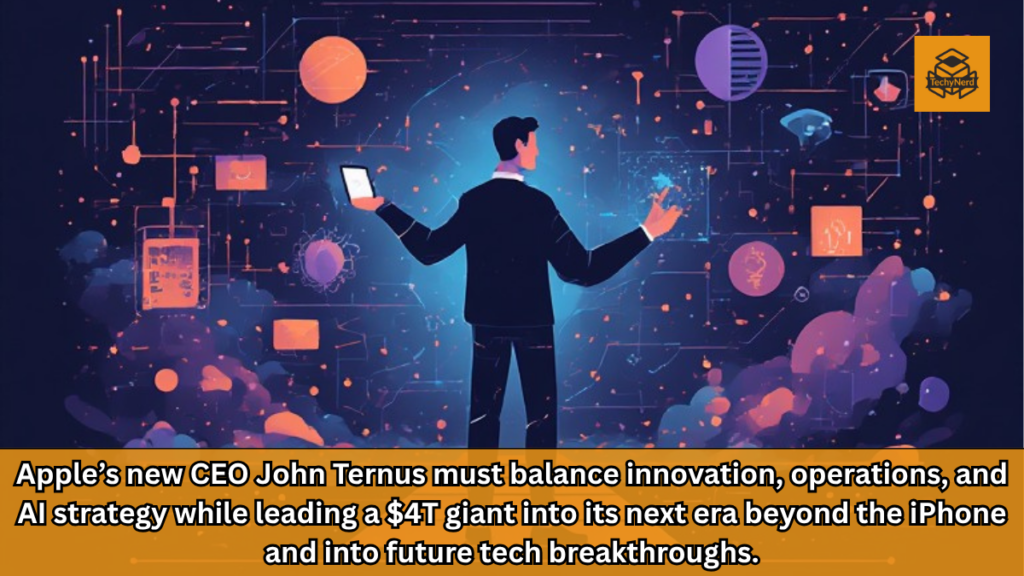
Ternus is stepping into a role that demands more than competence. It demands transformation.
The Dual Legacy: Innovation Meets Execution
To understand the magnitude of the challenge ahead, one must examine the contrasting legacies of Steve Jobs and Tim Cook. Jobs was widely regarded as a visionary, someone who could foresee consumer needs before they were even articulated. His leadership style was intense, product-focused, and driven by an obsession with perfection. Under his guidance, Apple introduced groundbreaking products that redefined entire industries.
Tim Cook, on the other hand, brought a different kind of brilliance to the company. Where Jobs was a creator, Cook was a builder. He transformed Apple into an operational powerhouse, optimizing its global supply chain and expanding its market reach. Under Cook’s leadership, Apple achieved unprecedented financial success, becoming one of the first companies to surpass trillion-dollar valuations and eventually reaching the $4 trillion milestone.
The challenge for Ternus lies in merging these two philosophies. He must be both visionary and executor, capable of inspiring groundbreaking innovation while maintaining the efficiency and scale that define Apple’s modern success.
The Burden of Expectations
Leadership transitions are always fraught with uncertainty, but in Apple’s case, the expectations are uniquely intense. Investors, consumers, and industry analysts are not simply looking for continuity; they are demanding evolution. They want the next transformative product, the next paradigm shift, and the next defining moment in consumer technology.
At the same time, they expect stability. Apple’s vast ecosystem, which includes hardware, software, and services, must continue to function seamlessly. Any disruption could have far-reaching consequences, not just for the company but for the global technology landscape.
Ternus must navigate this delicate balance, ensuring that Apple remains both innovative and reliable.
The iPhone Dilemma: Sustaining a Flagship
The iPhone remains the cornerstone of Apple’s business, generating a significant portion of its revenue. Its success is unparalleled, but it also presents a strategic challenge. Incremental improvements, while important, are no longer sufficient to drive the kind of excitement that once accompanied each new release.
Consumers are holding onto their devices longer, and the market has become increasingly saturated. This raises a critical question: what comes next?
Apple has attempted to diversify its product lineup with offerings such as wearables and spatial computing devices. However, none have yet matched the transformative impact of the iPhone. For Ternus, identifying and nurturing the next breakthrough product will be a top priority.
Apple Silicon: A Blueprint for Transformation
One of Ternus’s most notable achievements has been his leadership in transitioning Apple’s Mac lineup from Intel processors to Apple Silicon. This move was not merely a technical upgrade; it was a strategic transformation that gave Apple greater control over its hardware and software integration.
The success of Apple Silicon demonstrates Ternus’s ability to manage complex, large-scale transitions. It also highlights his understanding of the importance of vertical integration, a principle that has long been central to Apple’s philosophy.
As the company moves into the era of artificial intelligence, this experience will prove invaluable. The ability to integrate AI capabilities directly into hardware could become a defining factor in Apple’s future success.
The AI Crossroads
Artificial intelligence represents both an opportunity and a challenge for Apple. Unlike some of its competitors, Apple has taken a more cautious approach to AI development. This is partly due to its commitment to privacy and quality, which can be difficult to reconcile with the probabilistic nature of large language models.
However, the AI landscape is evolving rapidly, and Apple cannot afford to remain on the sidelines indefinitely. Under Ternus’s leadership, the company is expected to refine its approach, focusing on on-device AI capabilities that align with its core values.
This strategy could differentiate Apple from its competitors, offering users powerful AI features without compromising their data privacy. However, it will require significant investment and innovation.
Global Challenges and Geopolitical Pressures
In addition to technological challenges, Ternus must also navigate a complex geopolitical landscape. Apple’s global supply chain spans multiple countries, each with its own regulatory environment and political dynamics.
Balancing relationships with major markets such as the United States, China, and India will be critical. These regions are not only key to Apple’s manufacturing operations but also represent significant consumer bases.
Any misstep could have serious consequences, making this aspect of the CEO’s role as critical as product innovation.
Culture and Identity: Preserving the Apple DNA
One of Apple’s greatest strengths has been its corporate culture. The company’s emphasis on design, user experience, and attention to detail has set it apart from its competitors.
As Apple continues to grow, maintaining this culture becomes increasingly challenging. Ternus must ensure that the company does not lose its identity in the pursuit of scale.
This involves fostering an environment that encourages creativity while maintaining the discipline required for execution. It is a delicate balance, but one that is essential for long-term success.
The Road Ahead: Defining the Ternus Era
Every CEO leaves a unique imprint on the company they lead. For Ternus, the goal will be to define his own era, one that builds upon the successes of his predecessors while charting a new course for the future.
This will likely involve a renewed focus on hardware innovation, deeper integration of AI, and continued expansion of Apple’s ecosystem. It may also require bold decisions that challenge conventional wisdom.
Ultimately, the success of the Ternus era will be measured not just by financial performance but by Apple’s ability to remain at the forefront of technological innovation.
Conclusion: A Leadership Test Like No Other
Taking the helm of Apple is both an honor and a formidable challenge. John Ternus is stepping into a role that demands exceptional skill, vision, and resilience.
He must navigate the complexities of a rapidly changing industry, meet the expectations of a global audience, and lead one of the most influential companies in the world.
The task is daunting, but it is also an opportunity to shape the future of technology. If Ternus can successfully blend innovation with execution, he may not only meet expectations but redefine them.
FAQs
1. Who is John Ternus?
John Ternus is Apple’s former VP of hardware engineering, known for leading major product and chip transitions.
2. Why is this CEO transition significant?
Apple is one of the world’s largest companies, and leadership changes impact global tech trends.
3. What challenge does Ternus face?
He must combine innovation like Steve Jobs with operational excellence like Tim Cook.
4. How important is the iPhone to Apple?
It remains Apple’s primary revenue driver and core product.
5. What is Apple Silicon?
Apple’s in-house chip technology that powers Macs and enhances performance and efficiency.
6. Why is AI important for Apple now?
AI is reshaping technology, and Apple must compete while maintaining privacy standards.
7. Has Apple struggled with AI?
It has been cautious, focusing more on quality and privacy than rapid deployment.
8. What global challenges will Apple face?
Supply chain issues and geopolitical tensions in key markets.
9. Will Apple launch a new breakthrough product?
Investors expect a new category-defining innovation beyond the iPhone.
10. What defines success for Ternus?
Balancing innovation, growth, and maintaining Apple’s brand identity.