

Augmented reality has long been considered one of the most complex and resource-intensive domains in consumer technology. Major corporations invest billions into developing lightweight, powerful, and visually seamless AR glasses. These devices integrate advanced optics, custom silicon, and tightly engineered components that are nearly impossible to replicate outside industrial environments. Yet, the rise of the global maker movement continues to challenge this assumption.
A compelling example of this shift is the Onyx AR 2.0 project, a fully functional augmented reality headset built from scratch using accessible tools and components. Developed by a dedicated creator, this project demonstrates that even highly sophisticated technologies can be reimagined through ingenuity, modular design, and persistence.
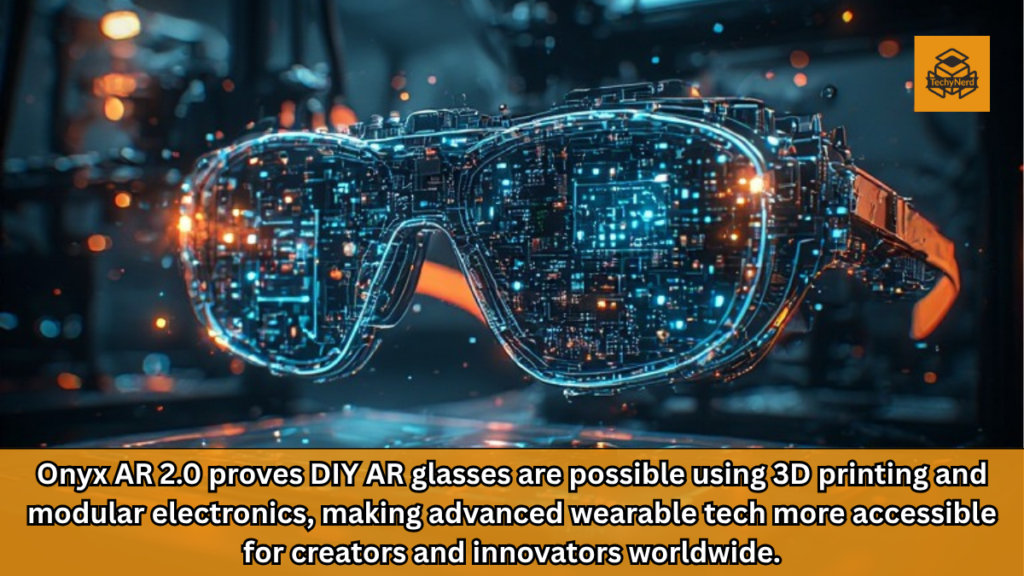
While Onyx AR 2.0 does not attempt to rival commercial devices in terms of size or polish, it offers something equally valuable: accessibility, customization, and a deeper understanding of how AR systems work at a fundamental level.
The Evolution of DIY Electronics and Its Expanding Scope
The concept of building electronics at home is not new. For decades, hobbyists have assembled radios, computers, and robotics systems using off-the-shelf components. However, the scope of what is achievable has expanded dramatically in recent years.
Advancements in 3D printing, affordable microcontrollers, and open-source software have lowered the barriers to entry. Devices that once required specialized manufacturing facilities can now be prototyped on a workbench. This shift has empowered individuals to experiment with cutting-edge technologies such as virtual reality, artificial intelligence, and augmented reality.
Onyx AR 2.0 sits at the intersection of these trends. It represents a new generation of DIY projects that push beyond simple experimentation and into the realm of functional, wearable computing.
Design Philosophy: Modularity Over Miniaturization
One of the most significant challenges in building AR glasses is miniaturization. Commercial devices achieve their sleek form factors through custom-designed components and highly optimized layouts. For hobbyists, replicating this level of integration is impractical.
The Onyx AR 2.0 project addresses this challenge by adopting a modular design philosophy. Instead of attempting to shrink every component to its smallest possible size, the system distributes functionality across different sections of the frame. Each module is responsible for a specific task, allowing the builder to work with standard-sized components.
This approach results in a device that is larger than commercial alternatives, but it offers several advantages. It simplifies assembly, improves repairability, and allows for easy upgrades. Users can modify individual modules without redesigning the entire system, making the device highly adaptable.
The Role of 3D Printing in Wearable Prototyping
3D printing plays a central role in the construction of Onyx AR 2.0. The frame and housing components are custom-designed and printed to accommodate the various electronic modules. This level of customization would be difficult to achieve with traditional manufacturing methods.
By leveraging 3D printing, the creator can iterate rapidly on design changes, adjusting the fit, weight distribution, and component placement. This flexibility is essential for wearable devices, where comfort and ergonomics are critical considerations.
The use of 3D printing also highlights a broader trend in hardware development. As additive manufacturing technologies become more accessible, they enable a new wave of innovation in personalized and small-scale production.
Power Management: The Foundation of Portable Electronics
At the heart of any wearable device lies its power system. Onyx AR 2.0 incorporates a custom-designed power management board that handles battery charging and voltage regulation. This component ensures that the device operates reliably and safely.
The system uses a single-cell lithium polymer battery, which is stepped up to a stable 5V output. This voltage is required to power the various electronic modules, including the display and wireless receiver. The inclusion of a tactile power switch and status indicators provides a straightforward user interface.
Effective power management is crucial for maintaining performance and extending battery life. In a DIY project, achieving this balance requires careful planning and an understanding of electrical engineering principles.
Display Technology: Creating the Augmented Reality Experience
The core of any AR system is its display technology. Onyx AR 2.0 utilizes a compact microdisplay paired with a dedicated driver board. This setup forms the visual interface that overlays digital content onto the real world.
The driver board converts incoming video signals into a format compatible with the display. A magnifier lens is used to adjust the focal distance, ensuring that the image appears clear and comfortable to the wearer.
A semi-transparent combiner serves as the optical element that merges the digital and physical environments. By reflecting the display image into the user’s eye while allowing external light to pass through, the combiner creates the illusion of augmented reality.
This optical arrangement, while simpler than those found in commercial devices, effectively demonstrates the fundamental principles of AR visualization.
Wireless Connectivity: Eliminating Physical Constraints
One of the standout features of Onyx AR 2.0 is its wireless capability. Instead of relying on physical connections, the device uses a video receiver module to accept a live feed from an external source.
This module, commonly found in automotive camera systems, has been repurposed to suit the needs of the project. It allows the glasses to receive real-time video without being tethered to another device.
In the demonstration setup, a single-board computer acts as the transmitter, streaming content directly to the headset. This configuration showcases the versatility of the system and its potential for various applications.
Wireless connectivity enhances the usability of the device, making it more practical for everyday experimentation and development.
Component Integration: Balancing Functionality and Form
Integrating multiple electronic components into a wearable form factor is a complex task. Onyx AR 2.0 achieves this by distributing components across the frame of the glasses.
The right side houses the primary electronics, including the battery and receiver, while the left side contains the display driver. This separation helps balance the weight and maintain structural stability.
Connections between modules are established באמצעות fine wiring and flexible cables, ensuring that the system remains functional without compromising mobility. This layout reflects a thoughtful approach to design, prioritizing both performance and usability.
Practical Applications and Limitations
While Onyx AR 2.0 is an impressive achievement, it is important to recognize its limitations. The device is not intended to compete with commercial AR glasses in terms of performance or aesthetics.
However, its value lies in its practicality for specific use cases. It can be used for prototyping, educational purposes, and experimentation with AR applications. Developers can explore new ideas without the constraints of proprietary hardware.
The project also highlights the trade-offs involved in DIY development. Achieving advanced functionality often requires compromises in size, weight, and refinement. Nevertheless, these challenges are part of the learning process and contribute to innovation.
The Broader Impact on the AR Industry
Projects like Onyx AR 2.0 have broader implications for the augmented reality industry. They demonstrate that innovation is not limited to large corporations and that individuals can contribute meaningfully to technological advancement.
By making AR more accessible, DIY projects encourage experimentation and creativity. This grassroots innovation can lead to new ideas and approaches that may influence future commercial products.
The growing interest in AR and wearable technology suggests that the demand for accessible development tools will continue to rise. As more people engage with these technologies, the pace of innovation is likely to accelerate.
The Future of DIY Wearable Technology
The success of Onyx AR 2.0 points to a future where DIY wearable technology becomes increasingly sophisticated. As tools and components continue to improve, hobbyists will be able to create more advanced and compact devices.
This trend has the potential to democratize hardware development, enabling individuals to build customized solutions tailored to their needs. It also fosters a deeper understanding of technology, empowering users to move beyond passive consumption.
In the long term, the line between professional and hobbyist development may continue to blur, creating new opportunities for collaboration and innovation.
Conclusion: A Testament to Creativity and Engineering Ingenuity
Onyx AR 2.0 is more than just a DIY project; it is a testament to what can be achieved with creativity, determination, and technical expertise. It challenges the notion that advanced technologies are out of reach for individuals and highlights the potential of modular design and accessible tools.
While it may not replace commercial AR glasses, it serves as an inspiration for makers and developers around the world. By breaking down complex systems into manageable components, it opens the door to a new era of experimentation and innovation in augmented reality.
FAQs
1. What is Onyx AR 2.0?
It is a DIY augmented reality headset built using 3D printing and modular electronics.
2. Can beginners build this project?
It requires intermediate to advanced skills in electronics and design.
3. How does the display system work?
It uses a microdisplay, lens, and combiner to overlay digital images on the real world.
4. Is the device fully wireless?
Yes, it uses a wireless video receiver for untethered operation.
5. What powers the device?
A lithium polymer battery with a custom power management system.
6. Can it replace commercial AR glasses?
No, it is designed for experimentation rather than competition.
7. What are the main challenges in building it?
Miniaturization, component integration, and power management.
8. What is the role of 3D printing?
It is used to create the custom frame and housing components.
9. Can the design be modified?
Yes, the modular approach allows for easy customization and upgrades.
10. What is the significance of this project?
It demonstrates that complex AR technology can be built at home.